Ships and watercraft
Ships and other watercraft are used for ship transport. Various types can be distinguished by propulsion, size or cargo type. Recreational or educational craft still use wind power, while some smaller craft use internal combustion engines to drive one or more propellers, or in the case of jet boats, an inboard water jet. In shallow draft areas, such as the Everglades, some craft, such as the hovercraft, are propelled by large pusher-prop fans.
Most modern merchant ships can be placed in one of a few categories, such as:
 | Bulk carriers, such as the Sabrina I seen here, are cargo ships used to transport bulk cargo items such as ore or food staples (rice, grain, etc.) and similar cargo. It can be recognized by the large box-like hatches on its deck, designed to slide outboard for loading. A bulk carrier could be either dry or wet. Most lakes are too small to accommodate bulk ships, but a large fleet of lake freighters has been plying the Great Lakes and St. Lawrence Seaway of North America for over a century.
|
 | Container ships are cargo ships that carry their entire load in truck-size containers, in a technique called containerization. They form a common means of commercial intermodal freight transport. Informally known as "box boats," they carry the majority of the world's dry cargo. Most container ships are propelled by diesel engines, and have crews of between 10 and 30 people. They generally have a large accommodation block at the stern, directly above the engine room.
|
 | Tankers are cargo ships for the transport of fluids, such as crude oil, petroleum products, liquefied petroleum gas, liquefied natural gas and chemicals, also vegetable oils, wine and other food - the tanker sector comprises one third of the world tonnage.
|
 | Reefer ships are cargo ships typically used to transport perishable commodities which require temperature-controlled transportation, mostly fruits, meat, fish, vegetables, dairy products and other foodstuffs.
|
 | Roll-on/roll-off ships, such as the Chi-Cheemaun, are cargo ships designed to carry wheeled cargo such as automobiles, trailers or railway carriages. RORO (or ro/ro) vessels have built-in ramps which allow the cargo to be efficiently "rolled on" and "rolled off" the vessel when in port. While smaller ferries that operate across rivers and other short distances still often have built-in ramps, the term RORO is generally reserved for larger ocean-going vessels.
|
 | Coastal trading vessels, also known as coasters, are shallow-hulled ships used for trade between locations on the same island or continent. Their shallow hulls mean that they can get through reefs where sea-going ships usually cannot (sea-going ships have a very deep hull for supplies and trade etc.).
|
 | Ferries are a form of transport, usually a boat or ship, but also other forms, carrying (or ferrying) passengers and sometimes their vehicles. Ferries are also used to transport freight (in lorries and sometimes unpowered freight containers) and even railroad cars. Most ferries operate on regular, frequent, return services. A foot-passenger ferry with many stops, such as in Venice, is sometimes called a waterbus or water taxi. Ferries form a part of the public transport systems of many waterside cities and islands, allowing direct transit between points at a capital cost much lower than bridges or tunnels. Many of the ferries operating in Northern European waters are ro/ro ships. See the Herald of Free Enterprise and M/S Estonia disasters.
|
 | Cruise ships are passenger ships used for pleasure voyages, where the voyage itself and the ship's amenities are considered an essential part of the experience. Cruising has become a major part of the tourism industry, with millions of passengers each year as of 2006. The industry's rapid growth has seen nine or more newly built ships catering to a North American clientele added every year since 2001, as well as others servicing European clientele. Smaller markets such as the Asia-Pacific region are generally serviced by older tonnage displaced by new ships introduced into the high growth areas. On the Baltic sea this market is served by cruiseferries.
|
 | Cable layer is a deep-sea vessel designed and used to lay underwater cables for telecommunications, electricity, and such. A large superstructure, and one or more spools that feed off the transom distinguish it.
|
 | A tugboat is a boat used to manoeuvre, primarily by towing or pushing other vessels (see shipping) in harbours, over the open sea or through rivers and canals. They are also used to tow barges, disabled ships, or other equipment like towboats.
|
 | A dredger (sometimes also called a dredge) is a ship used to excavate in shallow seas or fresh water areas with the purpose of gathering up bottom sediments and disposing of them at a different location.
|
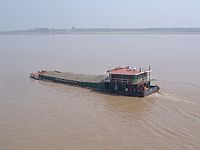 | A barge is a flat-bottomed boat, built mainly for river and canal transport of heavy goods. Most barges are not self-propelled and need to be moved by tugboats towing or towboats pushing them. Barges on canals (towed by draft animals on an adjacent towpath) contended with the railway in the early industrial revolution but were outcompeted in the carriage of high value items due to the higher speed, falling costs, and route flexibility of rail transport. |
Ships do exist that fall outside these categories, such as Semi-submersible heavy-lift ships or OHGC.
All about marine life-
A ship's complement can be divided into four categories: the deck department, the engineering department, the steward's department, and other.
Deck department

An able seaman stands iceberg lookout on the bow of the freighter USNS Southern Cross during a re-supply mission to
McMurdo Station, Antarctica; circa 1981.
Officer positions in the deck department include but not limited to: Master and his Chief, Second, and Third officers. The official classifications for unlicensed members of the deck department are Able Seaman and Ordinary Seaman.
A common deck crew for a ship includes:
A deck cadet is person who is carrying out mandatory seatime to achieve his/her officer of the watch certificate. Their time onboard is spent learning the operations and tasks of everyday life on a merchant vessel.
Engineering department
A ship's engineering department consists of the members of a ship's crew that operate and maintain the propulsion and other systems on board the vessel. Marine Engineering staff also deal with the "Hotel" facilities on board, notably the sewage, lighting, air conditioning and water systems. They deal with bulk fuel transfers, and require training in firefighting and first aid, as well as in dealing with the ship's boats and other nautical tasks- especially with cargo loading/discharging gear and safety systems, though the specific cargo discharge function remains the responsibility of deck officers and deck workers. On LPG and LNG tankers however, a cargo engineer works with the deck department during cargo operations, as well as being a watchkeeping engineer.
A common Engineering crew for a ship includes:
Many American ships also carry a Qualified Member of the Engine Department. Other possible positions include Motorman, Machinist, Electrician, Refrigeration Engineer, and Tankerman. Engine Cadets are trainee engineers who are completing sea time necessary before they can obtain a watchkeeping license.
Steward's department
A typical Steward's department for a cargo ship would be composed of a Chief Steward, a Chief Cook, and a Steward's Assistant. All three positions are typically filled by unlicensed personnel.
The chief steward directs, instructs, and assigns personnel performing such functions as preparing and serving meals; cleaning and maintaining officers' quarters and steward department areas; and receiving, issuing, and inventorying stores.
On large passenger vessels, the Catering Department is headed by the Chief Purser and managed by assistant pursers. Although they enjoy the benefits of having officer rank, they generally progress through the ranks to become pursers. Under the pursers are the department heads - such as chief cook, head waiter, head barman etc. They are responsible for the administration of their own areas.
The chief steward also plans menus; compiles supply, overtime, and cost control records. May requisition or purchase stores and equipment. May bake bread, rolls, cakes, pies, and pastries.
A chief steward's duties may overlap with those of the Steward's Assistant, the Chief Cook, and other Steward's Department crewmembers.
In the United States Merchant Marine, in order to be occupied as a chief steward a person has to have a Merchant Mariner's Document issued by the United States Coast Guard. Because of international conventions and agreements, all chief cooks who sail internationally are similarly documented by their respective countries.
Other Departments
Various types of staff officer positions may exist on board a ship, including Junior Assistant Purser, Senior Assistant Purser, Purser, Chief Purser, Medical Doctor, Professional Nurse, Marine Physician Assistant, and Hospital Corpsman, are considered administrative positions and are therefore regulated by Certificates of Registry issued by the United States Coast Guard. Pilots are also merchant marine officers and are licensed by the Coast Guard. Formerly, there was also a radio department, headed by a chief radio officer and supported by a number of radio officers. Since the introduction of GMDSS (Satellite communications) and the subsequent exemptions from carrying radio officers if the vessel is so equipped, this department has fallen away, although many ships do still carry specialist radio officers, particularly passenger vessels. Many radio officers became 'electro-technical officers', and transferred into the engineering department.


